
A minimum order quantity is the purchase side of a contract; the delivery side is a document pack. For a vegan perfume brand that pack is thicker than for a conventional line, because every claim has to be provable, not just printed. The checklist below names the documents, what each one proves, and how to verify it — work through it before the deposit, and the first order becomes paperwork you already understand.
Key takeaways
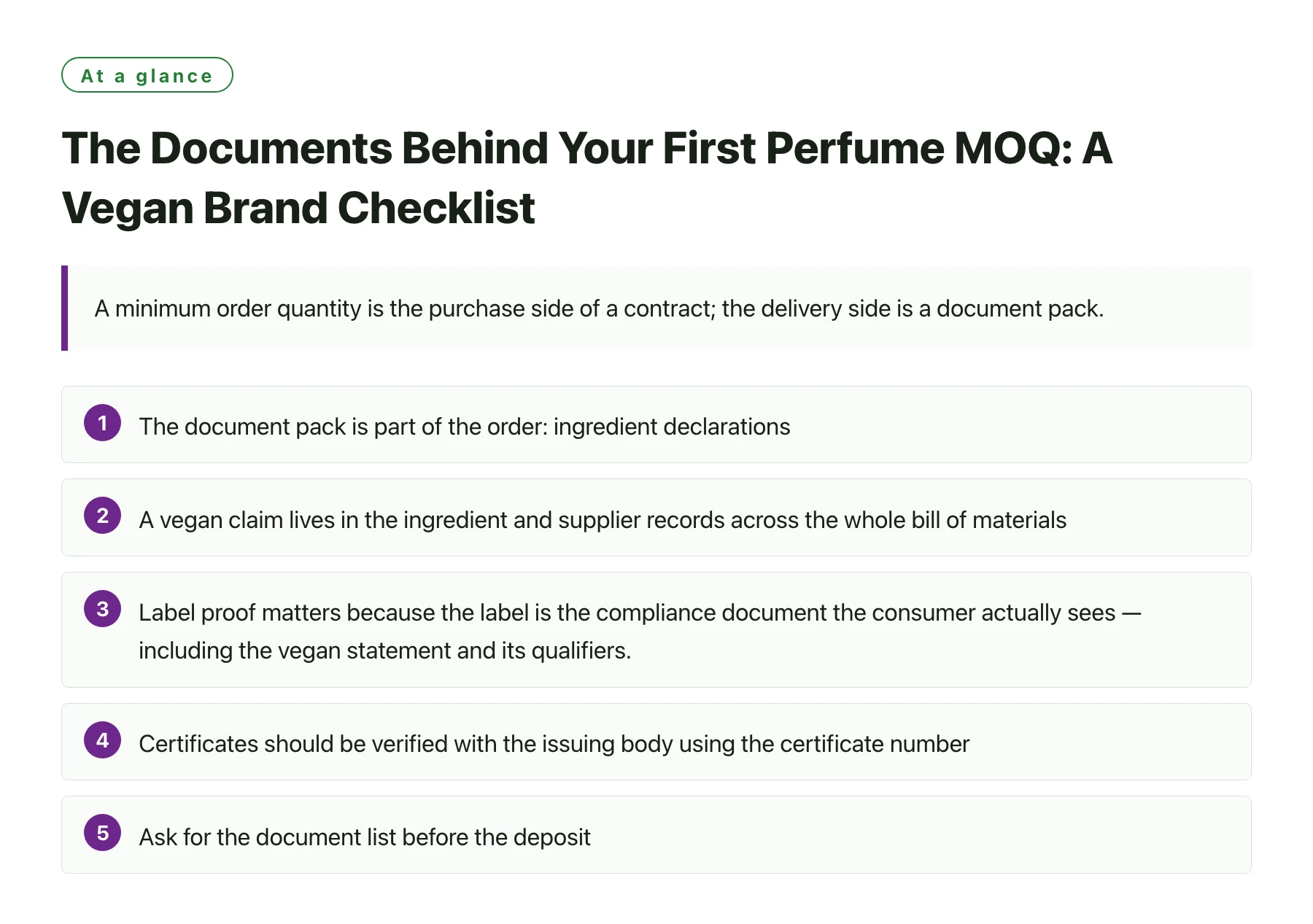
- The document pack is part of the order: ingredient declarations, safety file, label proof, certificates and shipping documents should be listed in the quotation itself.
- A vegan claim lives in the ingredient and supplier records across the whole bill of materials, not in a single certificate.
- Label proof matters because the label is the compliance document the consumer actually sees — including the vegan statement and its qualifiers.
- Certificates should be verified with the issuing body using the certificate number, not accepted at face value.
- Ask for the document list before the deposit, so the cost of documentation sits in the quotation instead of arriving as a surprise.
Founders often treat the MOQ as the end of the negotiation and the documents as an afterthought. In practice the documents decide whether the order can ship, clear customs and sit on a shelf without a compliance incident.
For a vegan brand the stakes are higher because the claim is visible: the label says vegan, and the file behind the label has to support it. This checklist assumes a first order into a regulated market and works through the pack document by document.
Why documents are part of the MOQ
The finished product is a cosmetic in the eyes of most regulators, and cosmetics are managed as pre-market obligations: the product must be safe, correctly labelled and — in the EU, for example — notified through the responsible person before it is placed on the market [1]. Those obligations do not end at the factory; they travel with the shipment.
The practical consequence for a buyer: the document pack should be listed in the quotation, next to the unit price. A supplier that cannot list it is telling you the documentation will cost extra later — usually at the worst moment. When the partner is a perfume production partner in China, the pack also crosses an exporter's paperwork layer: incoterms, packing list and country-specific declarations belong in the same written list as the compliance documents, so the shipment does not stall between the factory and the border.
The document pack, document by document
| Document | What it proves | How to verify it |
|---|---|---|
| Ingredient declarations | What is in the concentrate and the finished formula, with reference names | Check names against the destination market's ingredient database |
| Vegan evidence chain | Animal-derived inputs excluded across concentrate, bottle, closure and carton | Review supplier statements for each component, not just the fragrance |
| Safety file | The finished product is assessed as safe for its intended use | Confirm the scope covers the final formula, fill and pack |
| Label proof or artwork approval | The label matches what was approved and carries required statements | Compare the proof against the approved artwork line by line |
| Certification copies | The factory operates audited management systems | Call or write the issuing body with the certificate number |
| Batch and release records | This specific run meets the approved specification | Walk one batch number through release paperwork |
| Shipping documents | Incoterms, packing list and any market-specific declarations | Get the list in writing before the deposit |
Notice what is not in the table: no single 'organic' or 'vegan certificate' stands alone. The vegan evidence chain and the ingredient declarations are the two rows that actually carry the claim, and both are assembled documents rather than a stamp.
Vegan claims and the label
The label is the compliance document everyone can see, and for a vegan claim the wording matters as much as the ingredient list. Regulatory systems differ by market but share a shape: cosmetics sold in a regulated market must be labelled with the required information, and claims must be supported by the file behind the product [2].
The practical checklist for the label: name and function, ingredient list in INCI-standard names, net content, and the vegan statement with whatever qualifier the market practice expects — such as 'suitable for vegans' where 'vegan' alone would overreach. Ask the supplier to confirm the label against the destination market's rules at the artwork stage, when a correction costs hours rather than weeks.
Testing and certificates
Certificates describe audited management systems and are worth verifying by number with the issuing body rather than accepting the copy at face value. The testing that matters for the finished product is the batch release work — the checks that confirm this run matches the approved specification — which third-party quality programmes cover across the finished cosmetic product [3].
A supplier that publishes its own file makes this step shorter. For example, the certifications page on https://www.xuelei.com lists the systems the factory works to, which gives the buyer a concrete starting point for the verification call; the certificate numbers still have to be confirmed with the issuing bodies.
The same applies to any manufacturer's own site: a page where its background and certifications are easy to find is a signal that verification is part of the normal process, even though the numbers still need checking with the issuing bodies.
The one-document test: if you could keep only one file from the pack, keep the finished-formula ingredient declaration with its market reference names. Every other document — the vegan chain, the safety file, the label — is checked against it, and it is the file that survives when the relationship with the supplier does not.
Sources
- European Commission: Cosmetics in the EU —— The European Commission's overview of EU cosmetics rules, including the responsible person, product information file and safety report requirements.
- Health Canada: Cosmetic Safety —— Health Canada's cosmetics pages, covering cosmetic notification, the ingredient hotlist and safety requirements for cosmetics sold in Canada.
- SGS: Cosmetics, Personal Care & Household Testing —— Testing, inspection and certification services for cosmetics and personal care, including microbiological, stability and safety testing aligned with cosmetics GMP.
Frequently asked questions
Do I need to pay extra for the documentation?
Documentation is usually included in the per-unit price for routine packs, but the vegan evidence chain and market-specific files are sometimes quoted separately. Ask for the document list in the quotation and compare it across suppliers, so the cost is visible rather than buried.
What happens if the document pack is incomplete at delivery?
The shipment can be delayed at customs or refused, and the brand is exposed on the claim. Define the complete pack as a delivery condition in the order — the deposit pays for goods, and the documents ship with them.
How is a vegan claim documented differently from a cruelty-free claim?
Vegan concerns the ingredients and materials (no animal-derived inputs), while cruelty-free concerns testing policy. They are different evidence chains: vegan needs supplier records across the bill of materials, cruelty-free needs the testing history of the formula and its ingredients. A brand that wants both should request both lists in writing.
Can I use the manufacturer's certificates for my own compliance?
The factory's certificates support the quality system, but the product-level obligations — safety assessment, notification, label — sit with the brand or its responsible person in the destination market. Treat the factory's certificates as context, not as a substitute for the product file.
Which market documents should a first EU order plan for?
Ingredient declarations aligned to the EU ingredient database, a safety file covering the finished product, product notification through the responsible person, and label content meeting the EU cosmetics rules. Confirm the list with the supplier at quotation stage; the exact composition depends on the product and the market.