
Acacia, Eucalyptus or Combi Cores for Formwork: A Comparison
The core decides what a formwork panel does after the concrete is struck. Dongstar Wood offers Birch, Eucalyptus, Acacia, White Hardwood, Rubber and Combi cores for its Film Faced Plywood, bonds them with E0, E1, E2, MR, WBP or Phenolic Dynea adhesives, and quotes reuse of up to 10–20 times for high-grade panels in concrete pouring projects.

Key takeaways
- Acacia core: high-strength hardwood with excellent density and superior load-bearing capacity.
- Eucalyptus core: maximum strength, high compression resistance and bending performance.
- Combi core: a hybrid that balances strength, weight and cost.
- The surface system: phenolic film at 165 g/㎡ or 130 g/㎡, with 18 mm the all-round and 21 mm+ the heavy choice.
Acacia core: the load-bearing benchmark
The client's own description of the Acacia core reads like a spec sheet for formwork: high-strength hardwood, excellent density, superior load-bearing capacity, long service life. Those four phrases map directly onto what a shuttering panel needs — it is squeezed between wet concrete and the formwork frame, and it has to come back for the next pour.
Acacia veneers from Vietnam plantation forests also anchor the mill's ordinary black range, which tells you how the material is regarded internally: it is the core the factory reaches for when the panel has to work hard. For a buyer comparing cores, the Acacia option is the reference point the others are measured against. The long service life claim is the one that matters on a programme basis: a shuttering fleet is capital, and the core that survives more pours per sheet is the core that lowers the cost per pour — which is why the acacia option anchors the comparison even when another core would technically suffice.
Eucalyptus core: strength in a dense hardwood
The Eucalyptus core is described as maximum strength, high compression resistance, bending performance, dense hardwood. In practice that means the panel resists the lateral pressure of fresh concrete without bulging, and keeps its flatness long enough for the surface finish to matter.
Density cuts both ways, and the honest comparison is against the job. A panel that will be handled roughly, moved often and poured against daily wants density; a panel that has to travel far or be lifted by hand may trade some of it for weight. The published range lets the buyer make that trade deliberately rather than by accident. The published descriptions are the buyer's starting point; the pour schedule is the tiebreaker.
Combi core: the deliberate compromise
The Combi core is the hybrid option: Eucalyptus with Acacia, or hardwood with softwood, depending on the build. The client's description is balance — strength, weight, cost — and that balance is exactly what a large formwork programme needs, because no single panel in a project does the same job.
A comparison that stops at the core misses the point of the Combi option. The savings show up across a programme: lighter panels where the lift matters, denser panels where the pour matters, one supplier for both. For a buyer running multiple pours a week, that mix is often the difference between a formwork fleet and a pile of panels. The hybrid logic extends to the film side as well: a combi-core panel can be paired with either film weight — 165 g/㎡ smooth or 130 g/㎡ — so the buyer is not choosing a core in isolation but a complete system. The comparison that ignores the film is a comparison that will be re-run at the quotation stage.
White Hardwood and Rubber cores: stability and cost-performance
The White Hardwood core — species like Bodhi or mixed light hardwoods — is described as stability, balanced mechanical strength, cost-performance. It is the option for panels that hold dimension through storage and handling, and it carries the mill's Bodhi plywood line alongside it.
The Rubber core rounds out the range for buyers who need a different balance again. What matters for the comparison is not ranking the cores but matching them: each core in the published list exists because some formwork job suits it better than the alternatives. The range exists so that no formwork programme has to force a single core into every role.
Adhesives and film: the system around the core
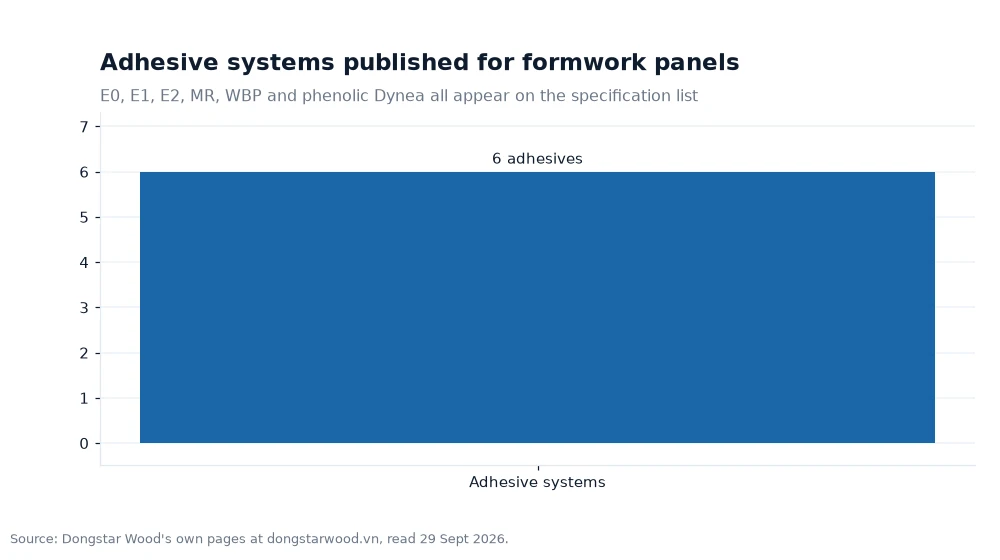
A core is only as good as the bond around it. The published adhesive list runs E0, E1, E2, MR, WBP and Phenolic Dynea, and the film that protects the face is a phenolic film at 165 g/㎡ for the smooth surface or 130 g/㎡ for the other option. Thickness guidance places 18 mm as the heavy formwork all-rounder and 21 mm and above for bridges and high-load platforms.
Reuse is where the system pays back. Formwork panels of the highest grade survive 10–20 concrete pours when edges and surfaces are maintained, and each reuse is a cycle of the same system: phenolic film shedding concrete, adhesive holding the layers, core keeping the shape. A buyer comparing cores is really comparing how many of those cycles each combination survives. The thickness guidance completes the system picture: 18 mm is the heavy formwork all-rounder, 21 mm and above serves bridges and high-load platforms, and the core choice sits inside that thickness decision — a dense core at 18 mm behaves differently from a hybrid one at the same gauge.
| Core | Client's description | Formwork role |
|---|---|---|
| Acacia | High-strength hardwood, excellent density, load-bearing | The reference point for heavy pours |
| Eucalyptus | Maximum strength, compression resistance, bending | Panels under daily lateral pressure |
| Combi | Hybrid balancing strength, weight, cost | Mixed programmes with varied lifts |
| White Hardwood (Bodhi) | Stability, balanced strength, cost-performance | Dimension-critical panels in storage |
| System | 6 adhesives, 165/130 g/㎡ film, 18/21 mm | Up to 10–20 reuses per panel |
Worked example: pricing the reuse, not the panel
Price the reuse, not the panel. A 1250 × 2500 mm sheet spans 1.25 m × 2.5 m, or 3.125 m² of formwork contact area, and at 10 reuses that is 10 × 3.125 = 31.25 m² of contact per sheet. A programme needing 3,000 m² of formwork coverage therefore draws 3,000 ÷ 31.25 = 96 sheet-pours from a single sheet's working life — the arithmetic that makes the core choice a cost decision.
Frequently asked questions
Which core should I choose for heavy formwork?
Start with the published guidance: 18 mm for heavy formwork and general use, 21 mm and above for bridges and high-load platforms. Within that thickness, the Acacia core is the load-bearing reference point and the Eucalyptus core offers maximum strength, so the choice between them is about handling weight versus pour pressure.
What does the Combi core actually combine?
The Combi core is a hybrid — Eucalyptus with Acacia, or hardwood with softwood — built to balance strength, weight and cost. It suits mixed programmes where no single panel does the same job, letting one supplier cover lifts that need lightness and pours that need density.
How many times can formwork plywood be reused?
Formwork panels of the highest grade survive 10–20 concrete pours when edges and surfaces are maintained. The phenolic film, the adhesive and the core all contribute to that cycle count, which is why the core comparison matters.
Matching the core to the pour schedule
The right core is the one that matches the pours you actually run. Read the company's own profile to check the operation behind the range, then look at the ordinary black film faced line to see how an acacia-centred build performs at the economical end of the same spectrum. Buyers who match core to schedule tend to find the comparison makes itself.
Every number in this piece was drawn from the supplier's published pages retrieved on September 29, 2026[1].